


WAGNA, an international and professional power solution brand, has been focusing on industrial engine research and development to supply reliable, durable, and environmental power solutions for global users. WAGNA is specialized in design, manufacture, installation and maintenance of engine, alternator, control system and generator sets. In the field of diesel generators. WAGNA D-series products provides power solutions for different kinds of power supply needs, including building construction, medical institution, road transport, industrial, oil exploration, mining, telecommunication, national defense, outdoor engineering etc. With capability of 120% overload. Wagna provides more possibilities for future expanding and stabilities of performance.
Leading Service
We are committed to constantly innovating our products to provide foreign customers with a large number of high-quality products to exceed customer satisfaction. We can also provide customized services according to customers' requirements such as size, color, appearance, etc. We can provide the most favorable price and high-quality products.
Quality Guaranteed
We have been continuously researching and innovating to meet the needs of different customers. At the same time, we always adhere to strict quality control to ensure that the quality of every product meets international standards.
Wide Sales Countries
Our products have been exported to more than 40 countries, such as Russia, Australia, USA, UK, Germany, Ukraine, Iran, Romania, Hungary, Mexico, Brazil, Chile, Canada, Spain, Colombia, etc. We have agents in the USA, Australia, Singapore, Kuwait, Russia.
Various Types of Products
In the field of new energy for gas power generation. WAGNA G series are devoted to developing and applying for renewable energy such as biomass gas, biogas, coal seam gas, petroleum gas and natural gas, and other clean energy, so that WAGNA products can provide a wide range of services in oil and gas exploration, coal mining, agricultural production, animal husbandry, landfills, kitchen waste, urban sewage treatment, etc. WAGNA gas generator sets are ranged from 20KVA to 4000KVA, and also provide optional services for CHP and a whole series of ancillary engineering services.
-
![High Damping Portable Small Power Single Cylinder High Efficiency 3KW Digital Inverter Generator]() High Damping Portable Small Power Single Cylinder High Ef...Brand name: Wagna. Model: W3100iS/W3100iSP digital inverter generator. Rated Power: 1kw. Warranty: 500 hours.
High Damping Portable Small Power Single Cylinder High Ef...Brand name: Wagna. Model: W3100iS/W3100iSP digital inverter generator. Rated Power: 1kw. Warranty: 500 hours. -
![Air Cooled Small Volume Prominent Performance Top Brand 2KW Digital Inverter Generator with Rocoil Starter]() Air Cooled Small Volume Prominent Performance Top Brand 2...Brand name: Wagna. Model: W1800iS/W1800iSP digital inverter generator. Rated Power: 1kw. Warranty: 500 hours.
Air Cooled Small Volume Prominent Performance Top Brand 2...Brand name: Wagna. Model: W1800iS/W1800iSP digital inverter generator. Rated Power: 1kw. Warranty: 500 hours. -
![Air-cooled Single Cylinder Small Size 1KW Digital Inverter Generator for Outdoor Activity]() Air-cooled Single Cylinder Small Size 1KW Digital Inverte...Brand name: Wagna. Model: W1100iS/W1100iSP digital inverter generator. Rated Power: 1kw. Warranty: 500 hours.
Air-cooled Single Cylinder Small Size 1KW Digital Inverte...Brand name: Wagna. Model: W1100iS/W1100iSP digital inverter generator. Rated Power: 1kw. Warranty: 500 hours.


From 1000 W to 6800 W ,Wagna Inverter generators are the most convenient gasoline/petrol generator.Its quiet operation, clean power, low fuel consumption, light-weight and portable features is accepted by farmer , worker, houseowner
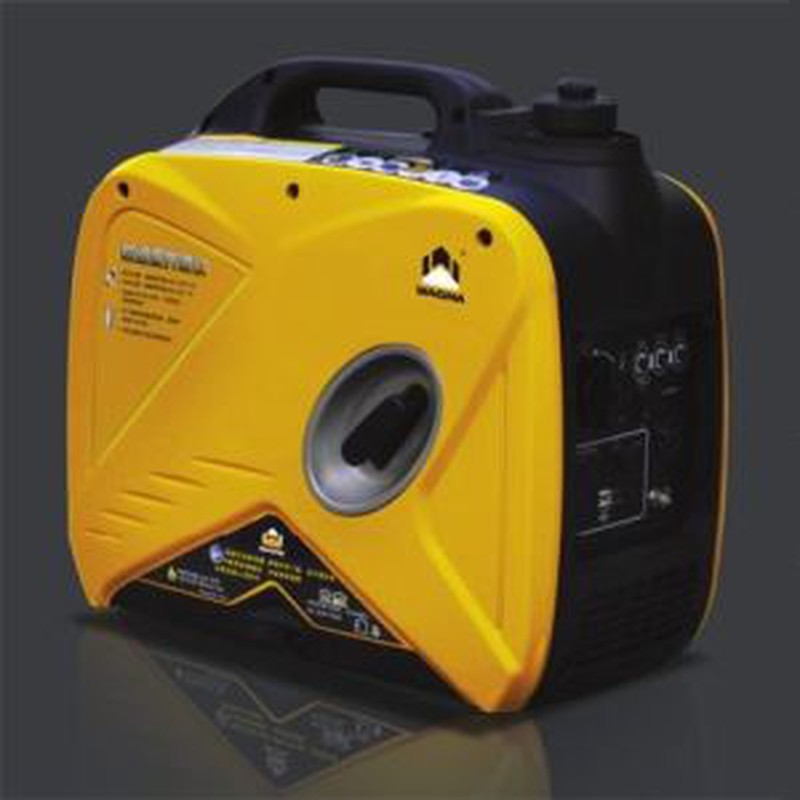
Digital Inverter Generators use advanced technology to convert direct current (DC) power produced by the engine into alternating current (AC) power, which can be used for various household appliances or tools. It is designed to generate clean, stable power in order to make the most efficient use of fuel and minimize emissions.
Advantages of an Digital Inverter Generator
Low Fuel Consumption: An Digital Inverter Generator does not need to run at 3600 rpm all the time to produce AC power. The engine speed auto-adjusts to the power drawn by the connected load. If the load is less then the engine will run at a lower speed resulting in less fuel consumption. On the other hand, conventional generators operate continuously at 3600 RPM, regardless of the power drawn by the connected load.
Clean Power: The AC power produced by an Digital Inverter Generator is free of harmonic distortion and is safe to use with small electronic devices. The output form of AC power is pure sine wave which is not known to harm household appliances and sensitive electronic equipment such as medical devices.
Parallel Operation: If one Digital Inverter Generator is not sufficient to meet your power demands, you can combine several of them to achieve the desired power output. This is something that is not possible with conventional generators.
Portability: Digital Inverter Generators for sale are mostly small and easy to carry to places. Their portability makes them an ideal power backup solution when camping. For example, the Anker SOLIX F1200 Portable Power Station. It weighs an impressive 19.95kg with a 1229Wh capacity and 1500 wattage - making this powerhouse perfect to power all your devices and appliances during any excursion.
Fuel Efficiency: Digital Inverter Generators are much more fuel-efficient than conventional fuel-powered generators. An Digital Inverter Generator automatically adjusts the speed of the engine to only what is required by the load, unlike conventional generators which operate at a constant speed. Running the generator at a lower speed saves energy, so less fuel is needed.
Cleaner Power: The inverter’s electronics technology produces a sine wave that outputs fewer fuel emissions and much cleaner power than a traditional generator. Higher quality electrical output means a safer environment for electronics. The quality of output also lends itself to parallel capability.
Easy Maintenance: Digital Inverter Generators require very little maintenance compared to their conventional counterparts. Maintenance is limited to battery inspection, which should be performed each month to ensure smooth operation.
Portability: Digital Inverter Generators are more lightweight than standard fuel-powered generators due to the smaller fuel tank. Most portable Digital Inverter Generator models are designed with carrying handles and wheels for easy mobility.
Generators have two main parts – an engine and an alternator. The engine consumes a fuel, like gasoline or propane, and turns a shaft. The alternator has two main components – a rotor and a stator. The engine shaft turns the rotor, which induces power in the stator. This power goes to the control panel, where it is used to power whatever you need – power tools, appliances, and more.
In a traditional generator, the power produced by the alternator is fed (more or less) straight to the control panel. It may go through a voltage regulator or other protective devices, but the power is not necessarily “cleaned up”. Therefore, the power produced by a traditional generator has a higher total harmonic distortion (THD) than the power produced by an Digital Inverter Generator. THD is a measure of how clean the power is – more on that in a moment.
An Digital Inverter Generator works differently. The alternating current (AC) power produced by the alternator is sent to a rectifier, which is a device that converts the AC power to direct current (DC). This DC power is then inverted back to AC power by the computer inside the generator before it is sent to the control panel. This is where the name “inverter” comes from. Because the power to the control panel is controlled by the computer, Digital Inverter Generators offer much lower THD than standard generators. THD is an important consideration when powering sensitive devices, like smartphones, tablets, computers, and televisions. These devices expect “clean” power (power that has low THD, like the wall power in your home), and can be damaged if they receive high-THD power. All WEN Digital Inverter Generators use pure-sine-wave inverters, and as such, limit THD to under 1% in most cases. Traditional generators can produce THD as high as 25% in some cases.
Digital Inverter Generators are generally more compact than traditional generators, and are much quieter, but have lower maximum power outputs and are more expensive. There are two main sub-types of Digital Inverter Generators: closed-frame and open-frame. Closed-frames are the most compact type of Digital Inverter Generator, as well as the quietest. Their protective shell contains noise-absorbing insulation, significantly reducing their acoustic impact. They are usually portable and suitable for powering small loads. Open-frame Digital Inverter Generators have no such insulation, and therefore are louder than closed-frames, but are still quieter than standard generators – usually about 50% quieter. Open-frame Digital Inverter Generators produce power that is just as clean as closed-frame inverters, and may be capable of handling larger loads.
How to Maintain Digital Inverter Generator
Top Generator Maintenance Tips
Want to stretch that Digital Inverter Generator lifespan for years? Follow these tried-and-tested generator maintenance tips to keep your unit in its best shape!
Read And Follow Your Manual
First and most importantly—when you get your generator, make sure to read the manual first. Everything you need from breaking in your unit to storage instructions would be there. This also prevents faulty handling, especially for first-time users, which can result in permanent damage early on.
Keep Your Air Filter Clean
To keep the quality of your generator at its best, clean the air filter every 50 hours or 3 months. You can easily do this with warm water and mild detergent. If your air filter shows any damage, replace it immediately with a new one.
Spark Plug Adjustment Is A Must
As the name suggests, the spark plug supplies the "spark" that ignites your generator's air/fuel mix to produce power. With such a crucial role, this part of your generator requires checking every three months and a yearly replacement to ensure optimal performance.
Run Your Generator Regularly
Like most technical equipment, leaving your generator idle for extended periods can result in damage and sluggish performance. Even during the off-season, when you're not likely to use it, try to run it for at least 20-30 minutes with load to test its condition.
Drain The Carburetor
Blocked or dirty carburettors are one of the most common causes of generator damage. Drain it after using your unit or replace it if necessary to avoid poor performance.
Clean Your Generator Before Storage
A clean, well-maintained generator will run smoothly for years, so see that you know how to keep yours free of dirt. Purchase a generator cover if necessary. Use a magnetic dipstick to remove accumulated debris inside the crankcase. Make sure all ventilation openings are not clogged. These little things may be simple but will go a long way when keeping your unit in top condition.
Practice Proper Storage
You want to keep your generator safe and ready for next use, so store it in a cool, dry place. Dust and dampness are the main enemies of electric components. You also want to drain all the fuel from the system and lubricate the engine's internals.
Fresh Oil Helps
As with any small-engine power equipment, changing the oil is a major factor in maintaining reliability.Change the Oil The majority of new generators need their first oil change to be done after just 30 hours of use. After the first oil change is completed, future oil changes only need to be done every 100 hours of use, or every season at the very least. To be prepared for unexpected extended power outages, stock up on oil, oil filters, and even gas.
Plugs & Filters
Plugs and Filters Without a way to breathe and a way to ignite the gas in the cylinders of the engine, your generator would be useless. Change your spark plug and air filter every 200 hours of use, or at least once at the start of each season. Having a new spark plug paired with a clean air filter will assure proper fuel-air mixture, helping the engine to run more efficiently and extending the lifespan of your generator.
Store It On An Empty Tank
Fuel Stabilizer If you're planning on putting your generator away in storage for longer than a month, be sure to drain the fuel from the tank. Start by adding quality gas stabilizer to the fuel in your tank, then run the unit for about 15 minutes. Let the engine cool down, then start and run the engine until it runs out of gas and shuts down. If there's a lot of gas left in the tank, you can use a siphon. Just be sure the siphon is non-conductive, to avoid generating static electricity in the tank.
Change The Battery
Not all portable generators will have a battery, but those that feature electric start should be fully charged before storing. If you can, plug the battery into a trickle charger to keep it fresh and ready when you need it.
Applications of Digital Inverter Generator
Home and Outdoors
They are most often used as reliable backup power sources in homes during power outages, ensuring that your appliances and lights continue to function. Not only that, but they are an ideal choice for outdoor lovers and campers due to their ability to power electronic devices, lights, and even portable fridges while maintaining a quiet camping atmosphere.
Construction Sites
Additionally, construction sites often benefit from Digital Inverter Generators as well, as they efficiently power tools and machinery while being easy to transport between job sites.
Parties and Events
Another place that may surprise you that is popular for Digital Inverter Generators is parties and events. With the convenience of Digital Inverter Generators, they can supply power for music, cooking equipment, and many more things around your home or venue.
Any Electronic Devices
Thanks to their low total harmonic distortion (THD), Digital Inverter Generators protect any of your electronics, like laptops, smartphones, and televisions. This essentially means that the voltage will be less volatile, which would originally cause major problems for your electronics.
Caravans and Cabins
Finally, in remote or off-grid locations, these generators can function as your primary power source for your home, cabin, caravan, and many more, as they can deliver consistent electricity without needing any access to the national grid.
FAQ
Guangdong Wagna Power Technology Co., Ltd. is well-known as one of the leading digital inverter generator manufacturers and suppliers in China. If you're going to buy durable digital inverter generator at competitive price, welcome to get more information from our factory.
Digital Inverter Generator, inverter generator, portable generator

